MOOWR: manufacturing in a customs bonded warehouse under section 65
MOOWR, the Manufacture and Other Operations in Warehouse (No. 2) Regulations, 2019, lets you manufacture inside a licensed private bonded warehouse under section 65 of the Customs Act, 1962. Import duty on the imported inputs in finished goods is paid when those goods are cleared into India. Imported inputs in goods you export pay no import duty.
Published and updated
What is MOOWR?
MOOWR is the customs scheme that lets the owner of warehoused goods manufacture, or carry out other operations, inside a bonded warehouse with the Commissioner's permission under section 65(1) of the Customs Act. It runs under Notification No. 69/2019-Customs (N.T.) of October 1, 2019, which made the Manufacture and Other Operations in Warehouse (No. 2) Regulations, 2019.
CBIC, the Central Board of Indirect Taxes and Customs, set out the procedure the same day in Circular No. 34/2019-Customs, opens in a new tab. Its one form covers the warehouse licence and the section 65 permission (para 5). Para 6 sets the records a unit keeps and one bond for both MOOWR and section 59 of the Act.
For the rest of India's customs rules, see Customs in India: duty, valuation, origin and disputes.
How does the duty deferral under MOOWR work?
MOOWR defers import duty on imported inputs until the finished goods are cleared into India, and then it's paid on the inputs they contain (regulation 14(1)). Imported inputs in finished goods you export pay no import duty (Circular 34/2019, para 7). Goods you buy in India pay the normal taxes, because section 65 status alone doesn't make them tax free.
| Goods | Duty | Source |
|---|---|---|
| Imported inputs in finished goods cleared into India | Import duty, with any interest, fine and penalties, paid on the inputs those goods contain, when they leave the warehouse | Regulation 14(1), opens in a new tab; Circular 34/2019, para 8 |
| Imported inputs in finished goods exported | No import duty on the inputs those goods contain | Circular 34/2019, para 7 |
| Capital goods, machinery and inputs imported into the unit | Imported under the warehousing chapter, Chapter IX of the Customs Act | Circular 34/2019, para 11 |
| Goods bought in India | The normal taxes, with any exemption that applies; no tax-free buying from section 65 status alone | Circular 34/2019, para 11 |
| Finished goods sold in India | GST, and compensation cess if any, on a GST invoice, as a supply under the GST laws | Circular 34/2019, para 8 |
What licence and permission do you need for MOOWR?
MOOWR needs a private bonded warehouse licence under section 58 and permission to manufacture under section 65, both from the Principal Commissioner or Commissioner of Customs. You can apply for both together (regulation 4(1); Circular 34/2019, para 4). The permission stays valid until it's canceled or surrendered, or the section 58 licence is canceled or surrendered (regulation 6).
1. Hold or seek a section 58 licence
Either you already hold a private bonded warehouse licence under section 58, opens in a new tab, or you apply for one with the section 65 permission (regulation 4(1), opens in a new tab). Circular No. 34/2019-Customs, opens in a new tab puts both on one form (paras 4 and 5).
2. Apply online
Since November 15, 2025, applications for section 65 permission go through CBIC's online module on ICEGATE 2.0 (Circular No. 28/2025-Customs, opens in a new tab, para 1). Chief Commissioners name by public notice the port codes that take applications in their areas (para 4).
3. Give the undertakings
Undertake to keep digital accounts of goods received and removed and send them to the bond officer monthly, to execute a bond, and to state input-output norms where needed (regulation 4(2)).
4. Get the permission
After checking the application, the Principal Commissioner or Commissioner grants permission to operate under the regulations (regulation 5, opens in a new tab). It lasts until it's canceled or surrendered, or until the section 58 licence is (regulation 6, opens in a new tab).
5. Appoint a warehouse keeper
Name a warehouse keeper with experience of warehousing and customs procedures, who holds a digital signature for filing electronic documents (regulation 7, opens in a new tab).
What must a MOOWR site look like?
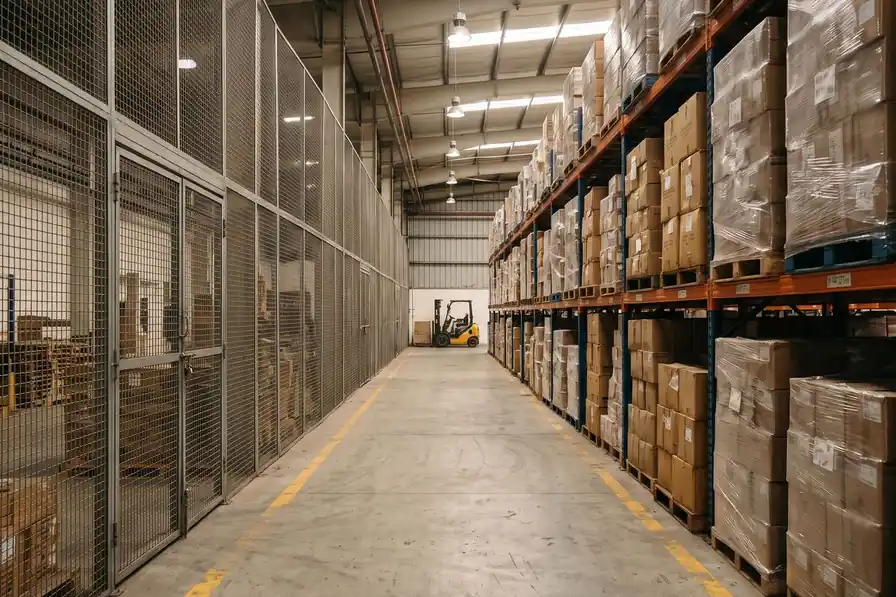
A MOOWR site doesn't need a building closed on all sides. Circular 34/2019 says what matters is that the site suits secure storage and compliance, with proper boundary walls, gates with access control and staff to guard the premises (para 13). Depending on their goods, operations and industry, some units may operate without fully closed structures.
Regulation 8, opens in a new tab asks for signage showing the site is a customs bonded warehouse. It also asks for a computerized system that accounts for goods received, stored, worked on and removed, and enough facilities, equipment and staff to control access and keep the goods secure.
Do you need permission for each removal of goods?
MOOWR units need no prior permission from the proper officer for each removal of finished goods. They still file the documents and pay the duty due (Circular 34/2019, para 15.1). CBIC set this up under section 143AA of the Customs Act, which lets the Board, CBIC, set separate procedures for a class of importers to speed clearance and cut costs.
Records take the place of permissions. Regulation 17, opens in a new tab has a unit keep records of goods received, handled, stored and removed for at least five years from removal, with a digital copy off site. A monthly return is due to the bond officer within ten days after the month ends.
Goods moving from the port to the warehouse, between warehouses or out for export travel under a one-time lock, unless the Commissioner allows otherwise (regulation 9, opens in a new tab).
What changed for MOOWR warehouses in 2026?
Section 67 of the Customs Act changed in 2026. Section 150 of the Finance Act, 2026 rewrote it from April 1, 2026: the owner of warehoused goods may move them from one warehouse to another, subject to conditions set by regulations. Section 67 no longer asks for the proper officer's permission, which Circular 34/2019 said it required (para 15).
CBIC's text of section 67, opens in a new tab gives the Finance Act's date, March 30, 2026, and the start date. We read no regulations setting the new conditions by November 7, 2026.
CBIC has also put draft warehouse licensing regulations out for comments. Our insight CBIC drafts one set of customs warehouse licensing regulations explains how the draft of August 19, 2026 would replace the three 2016 warehouse licensing regulations with one online form.
For CBIC's notifications and circulars in 2026, see our Customs tracker.
Is section 65A in force?
Section 65A of the Customs Act isn't in force. Section 65A itself applies only from a date the central government notifies, and CBIC's text of section 65 marks the words that tie it to section 65A "to be notified" (footnote 2). The text still read so on November 7, 2026, so section 65 runs without it.
Section 65A, opens in a new tab, inserted by Act No. 8 of 2023, would change how goods enter a section 65 warehouse. They would come in with their integrated tax (IGST) and GST compensation cess already paid, and only the other import duties would stay deferred (section 65A(1)).
Goods deposited before the notified date would stay outside it, and the government could exempt goods or sectors by notification (section 65A(2) and (3)).
How does MOOWR compare with IGCR, Advance Authorization and EPCG?
MOOWR defers import duty on goods processed in a bonded warehouse. IGCR (Import of Goods at Concessional Rate) lowers duty under an exemption tied to how you use the goods. Advance Authorization and EPCG (Export Promotion Capital Goods) are export schemes of DGFT, the Directorate General of Foreign Trade. The right route depends on your import and export mix.
| Route | Run by | What it does for import duty | Source |
|---|---|---|---|
| MOOWR | CBIC (Customs) | Defers duty until finished goods are cleared into India; none on inputs in exported goods | MOOWR regulation 14(1); Circular 34/2019, para 7 |
| IGCR | CBIC (Customs) | A lower rate under an exemption that depends on the goods' use, such as manufacture; Form IGCR-1 and a continuity bond | IGCR Rules, 2022, rule 2(b), opens in a new tab and rule 4, opens in a new tab |
| Advance Authorization | DGFT | Duty-free import of inputs physically built into an export product | Foreign Trade Policy 2023 (Chapter 4 Revised FTP 2026), opens in a new tab, para 4.03(a) |
| EPCG | DGFT | Capital goods at zero customs duty, against an export obligation of 6 times the duties, taxes and cess saved, to be met in 6 years | Foreign Trade Policy 2023 (Chapter 5 Revised FTP v1.2.2), opens in a new tab, para 5.01(a) and (b) |
Deferred payment is the other way to pay later, without a bonded warehouse: the government can let certain classes of importers pay duty later (section 47(1), opens in a new tab, second proviso). See Deferred payment of customs duty, Eligible Manufacturer Importers and AEO status.
How IndusDesk helps with MOOWR
We work out with your team whether bonded manufacturing fits your import and export mix, and prepare the licence and permission case with you. We watch the authorities, tell you what each change means for your products and plans, represent you while a decision is still open, and carry the work through, with every step on record in your workspace.
Frequently asked questions
Are the MOOWR regulations 44/2019 or 69/2019?
The MOOWR regulations in force are the No. 2 regulations, made by Notification No. 69/2019-Customs (N.T.) of October 1, 2019 (CBIC's text, opens in a new tab). Notification No. 69/2019 made them "in supersession of" the first 2019 set, Notification No. 44/2019-Customs (N.T.) of June 19, 2019, the date Circular No. 34/2019-Customs, opens in a new tab gives (para 1). A page that still cites 44/2019 is out of date.
Is there an online application for section 65 permission?
Yes. CBIC launched a dedicated online module for section 65 permissions on November 15, 2025, for MOOWR units and for special warehouses licensed under section 58A (Circular No. 28/2025-Customs, opens in a new tab, para 1). A page that says there's no online application predates it.
Do I need permission to move goods between warehouses now?
Section 67 no longer asks for it. Since April 1, 2026, the owner of warehoused goods may move them between warehouses, subject to conditions set by regulations (section 2(32), opens in a new tab; section 67, opens in a new tab, as the Finance Act, 2026 rewrote it). MOOWR regulation 13, opens in a new tab still has a unit send goods to another warehouse with notice to the bond officer on the transfer form.
Can a foreign company apply for MOOWR?
The joint application form asks the applicant to declare that it is a registered or incorporated entity in India (Circular No. 34/2019-Customs, opens in a new tab, Annexure A, Part II, item 11). Nothing in section 65, the MOOWR regulations or the circular limits who owns that entity, and none of them provides for a company with no Indian entity to apply from abroad. See Indian customs for foreign companies.
Sources
- Customs Act, 1962, section 65 (CBIC's consolidated text, fetched November 7, 2026): sub-section (1) and footnote 2, opens in a new tab
- Customs Act, 1962, section 65A, inserted by Act No. 8 of 2023, with effect from a date to be notified (CBIC's consolidated text): sub-sections (1) to (3), opens in a new tab
- Customs Act, 1962, section 67, as substituted by section 150 of the Finance Act, 2026 of March 30, 2026, from April 1, 2026 (CBIC's consolidated text), opens in a new tab
- Customs Act, 1962, section 2(32): "prescribed" means prescribed by regulations made under the Act (CBIC's consolidated text), opens in a new tab
- Customs Act, 1962, section 58: licensing of private warehouses (CBIC's consolidated text), opens in a new tab
- Customs Act, 1962, section 143AA: power to simplify procedure to facilitate trade (CBIC's consolidated text), opens in a new tab
- Customs Act, 1962, section 47(1), second proviso: deferred payment of duty (CBIC's consolidated text), opens in a new tab
- Notification No. 69/2019-Customs (N.T.), October 1, 2019: Manufacture and Other Operations in Warehouse (No. 2) Regulations, 2019, and its opening words superseding the first 2019 regulations (CBIC's consolidated text), opens in a new tab
- MOOWR (No. 2) Regulations, 2019, regulations 4 to 9, 13, 14 and 17 (CBIC's consolidated text; regulation 4 linked), opens in a new tab
- Circular No. 34/2019-Customs, October 1, 2019: Procedure for manufacturing or other operations in bonded warehouses under section 65, paras 1, 2, 4 to 8, 11, 13, 15 and 15.1, and Annexure A, opens in a new tab
- Circular No. 28/2025-Customs, November 15, 2025: Launch of Online Module for Permissions under Section 65 (MOOWR and MOOSWR), paras 1 and 4, opens in a new tab
- Customs (Import of Goods at Concessional Rate of Duty or for Specified End Use) Rules, 2022, rules 2(b) and 4 (CBIC's consolidated text; rule 2 linked), opens in a new tab
- Foreign Trade Policy 2023, Chapter 4 (compiled August 17, 2026), para 4.03(a), opens in a new tab
- Foreign Trade Policy 2023, Chapter 5 (compiled July 30, 2026), para 5.01(a) and (b), opens in a new tab