BIS licence for furniture: how to get the ISI mark
To get a BIS licence for furniture, you apply on Manak Online for each product standard and each factory. You test each family's lead model at a BIS-recognized lab, pass BIS's factory inspection and pay the licence and marking fees. BIS says grant generally takes about one month under option 2 and four months under option 1.
Published and updated
Who needs a BIS licence for furniture?
The maker of each of the six products in the Furniture QCO needs a Scheme-I licence (S.O. 801(E), para 2): work chairs, general purpose chairs and stools, tables and desks, storage units, beds and bunk beds. BIS takes one application per product and Indian Standard, and one per factory (BIS FAQ Q10 and Q11).
A BIS licence lets a maker put the ISI mark, BIS's Standard Mark, on goods that meet the Indian Standard (BIS FAQ Q1 and Q7). It covers only the products and varieties named in its scope (Q24). Compare BIS licences in India.
An importer can't apply for the foreign maker. Under BIS's scheme for foreign factories, only the foreign manufacturer can apply (FMCS FAQ 17). Read how to import furniture into India.
Some Udyam-registered makers are outside the order. Their investment in plant and machinery or equipment must be no more than ₹1 crore, and their turnover in the previous financial year no more than ₹5 crore (S.O. 777(E), opens in a new tab, S. No. 8). See the furniture QCO rules for MSMEs.
For the whole order and its exemptions, see our furniture QCO guide.
How do you get a BIS licence for furniture?
You get a BIS licence for furniture in seven steps, from choosing the standard to keeping the licence in good standing. The work turns on testing one lead model per family and passing BIS's factory visit, all on Manak Online (BIS FAQ Q7).
1. Choose the standard
Match each product to its standard, IS 17631 to IS 17636, one application each. See the six furniture standards explained.
2. Group your models into families
Declare every model with its drawing. Group models that share the manual's essential parameters, and name each family's most adverse model as lead (January 2026 manuals, Annex A).
3. Test each lead model
Under option 2, get a report first from a lab BIS runs, recognizes or empanels, generally no more than 90 days old (BIS FAQ Q13; Guidelines for Grant of Licence, para 4(e)). Under option 1, BIS draws samples at its visit (Guidelines for Grant of Licence, para 3(c)).
4. Apply on Manak Online
File Form-V with a self-evaluation report. Pay the ₹1,000 application fee and 50% of the annual minimum marking fee (Guidelines, paras 2 and 14(a); BIS FAQ Q14).
5. Host BIS's factory visit
Pay the inspection fee before the visit: ₹7,000 per man-day (BIS FAQ Q14; Guidelines, para 12). For an Indian factory the visit normally lasts one day and covers your plant, testing arrangements and samples (Guidelines, paras 1(a) and 5).
6. Pay the grant fees
On grant, pay the ₹1,000 annual licence fee and the marking fee balance, then mark every piece in scope (BIS FAQ Q14; Guidelines, para 7(d)(i)).
7. Keep the licence in good standing
Follow the quality plan you declared, keep test records and renew before the last date of validity (January 2026 manuals, Annex C, paras 1.2 and 2.1; BIS FAQ Q19 and Q20).
See every fee BIS charges for a furniture licence. Our regulatory and trade advisory desk can do this work with you.
Which route applies to furniture: option 1 or option 2?
BIS's Guidelines for Grant of Licence of February 25, 2026 list IS 17633 (tables and desks) and IS 17634 (storage units) under option 2, at items 804 and 805 of Annexure-II(C). We haven't found IS 17631, IS 17632, IS 17635 or IS 17636 in that list.
Under option 2 you apply with lab reports in hand. Under option 1, BIS draws samples at its visit (Guidelines for Grant of Licence, opens in a new tab, paras 3 and 4). IS 17631, IS 17632, IS 17635 and IS 17636 aren't in its option 1 list (Annexure-II(B)) or its factory testing list (Annexure-II(A)) either.
| Step | Option 1 | Option 2 |
|---|---|---|
| Product test report with the application | Not needed (paras 3(a) and 3(c)) | Needed, from a lab BIS runs, recognizes or empanels (paras 4(b) and 4(e)) |
| Age of the test report | No report at application | Up to 90 days; the oldest of several up to 180 days (para 4(f)) |
| Factory visit | Normally 1 day for an Indian maker (para 5(a)) | Normally 1 day; BIS draws 1 sample and 1 counter sample (paras 5(a) and 5(f)(ii)) |
| Testing the sample BIS draws | Paid by you (para 15(a)) | Covered by the marking fee (para 15(b)) |
| When BIS grants | Once the samples conform (para 7(a)) | Once BIS sees proof that the sample went to the lab and the advance marking fee was paid; a failed sample means suspension (paras 7(b) and 8(a)) |
| Raw material test reports | With the application, where the standard requires them (para 4(h)(iii)) | The same (para 4(h)(iii)) |
How long does a BIS licence for furniture take?
BIS says grant generally takes about one month under option 2 and four months under option 1, from receipt of a complete application and its recording. It varies with replies to BIS, inspections, samples and fee dues (BIS FAQ Q15). For a foreign factory, BIS says about six months (FMCS FAQ 12).
BIS's Guidelines expect a grant within 30 days of the application under option 2 and 90 days under option 1, when everything passes the first time (paras 7(a) and 7(b)).
Foreign factories use BIS's Foreign Manufacturers Certification Scheme (FMCS FAQ 1). See BIS certification for foreign furniture manufacturers.
BIS's circulars on the first licence for each standard are dated:
- Tables and desks, IS 17633: June 18, 2025, opens in a new tab
- Work chairs, IS 17631: August 20, 2025, opens in a new tab
- Beds, IS 17635: September 18, 2025, opens in a new tab
- General purpose chairs and stools, IS 17632: October 21, 2025, opens in a new tab
- Bunk beds, IS 17636: December 16, 2025, opens in a new tab
We found none for storage units (IS 17634).
Do you need your own testing laboratory?
No. BIS circular CMD-I/2:4:1 of December 16, 2025 says "There is no obligation to maintain in-house laboratory". You can use a common or cluster testing facility, or an outside lab that BIS recognizes or empanels or that is accredited to ISO/IEC 17025 (para 1). Furniture isn't among the products it leaves out (para 3).
The circular also says the manuals' testing schemes are only recommended, so you may declare your own quality plan (CMD-I/2:4:1, opens in a new tab, para 2). Keep test records, outside labs' reports included (January 2026 manuals, Annex C, para 2.1).
BIS's June 2025 manuals had made an in-house lab for routine tests optional for MSME makers, while large makers needed their own or a shared one (PM/IS 17631/2, opens in a new tab, Annex C, paras 2.2 to 2.3.1). On February 12, 2026, the MSME Ministry told the Lok Sabha the requirement "has been relaxed ... for all manufacturers" (Unstarred Question 2075, opens in a new tab).
IndusDesk worked on this rule with FICCI: we gathered industry input, analyzed it and the grouping guidelines, and represented to the government. Read our work with FICCI on the in-house laboratory rule.
How does family grouping work for furniture?
You group models that share the same essential parameters into a family, and a lab tests one lead model for all of them. The lead model must be the family's most adverse for safety, design, load-bearing material and size. BIS's January 2026 manuals cover all six standards this way.
| Standard | Essential parameters a family must share |
|---|---|
| IS 17631 Work chairs | Reclining or not; castors or not; footrest or not; maximum user mass and weekly usage hours (IS 17631, clause 7.1) |
| IS 17632 Chairs and stools | Chair or stool; Type 1 (domestic) or Type 2 (institutional); castors or not; footrest or not |
| IS 17633 Tables and desks | Office or domestic; castors or not; fixed or adjustable height |
| IS 17634 Storage units | Test Level 1, 2 or 3; castors or not; seating surface or not |
| IS 17635 Beds | Headboard or not; storage or not |
| IS 17636 Bunk beds | Storage or not |
- Testing the lead model covers every model in its family (January 2026 manuals, opens in a new tab, para 3(a) or 4(a)).
- A new model that BIS accepts as less adverse than the lead model joins with no inclusion charge (para 5 or 6).
- A new family or a new lead model goes through Regulation 10 of Scheme-I (same paragraph).
- BIS tests the models in rotation while the licence runs, as far as it can (para 6 or 7).
The June 2025 manuals were stricter: they grouped chairs and tables only within 10% of the lead model's size (PM/IS 17631/2, opens in a new tab, Annex A, para 2(b)). The December 2022 bed manuals tested each model (PM/IS 17635/1, opens in a new tab and 17636/1, opens in a new tab, Annex A, para 2). BIS's product manual page on bis.gov.in still linked these older manuals on October 28, 2026.
Where can furniture be tested?
Furniture can be tested at any lab BIS recognizes for its standard. BIS's directory, LIMS, listed 16 to 18 such labs per standard on October 28, 2026. For an option 2 grant, BIS accepts reports from labs it runs, recognizes or empanels (Guidelines for Grant of Licence, para 4(e)).
| Standard | Recognized labs on BIS LIMS |
|---|---|
| IS 17631 Work chairs | 17 labs |
| IS 17632 Chairs and stools | 16 labs |
| IS 17633 Tables and desks | 17 labs |
| IS 17634 Storage units | 18 labs |
| IS 17635 Beds | 18 labs |
| IS 17636 Bunk beds | 16 labs |
Search by standard number on BIS's LIMS lab search, opens in a new tab. In June 2025, India told the WTO that three labs were recognized for furniture (trade concern 828, opens in a new tab).
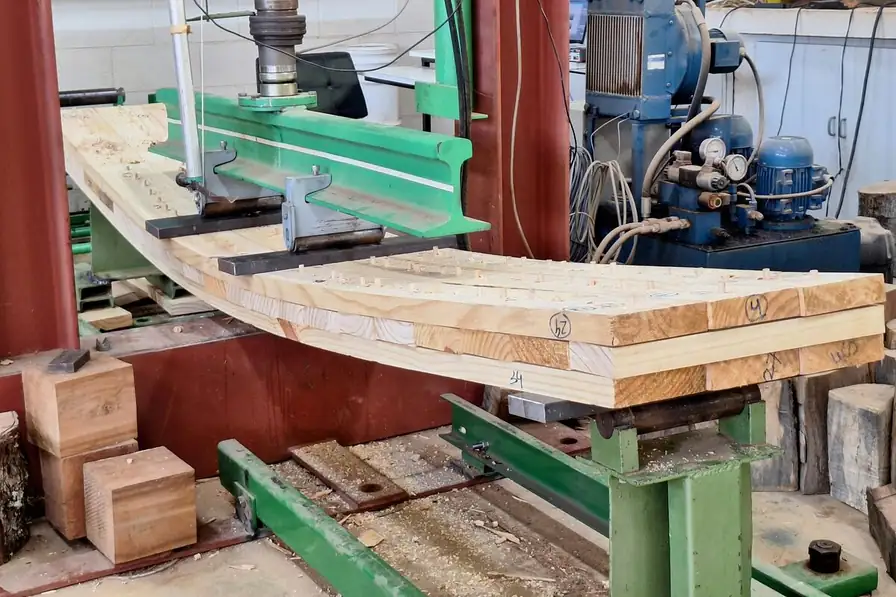
A lab sample is 2 chairs, tables or beds, or 1 storage unit (January 2026 manuals, section 2(c)).
How long is a BIS licence for furniture valid?
BIS grants a Scheme-I licence for up to two years at first, for the varieties named in it. You renew it on Manak Online with production details and the fee, for up to five years from the last date of validity (BIS FAQ Q18 and Q19).
BIS sets the actual marking fee from those production details (Q19). The MSME Ministry told the Lok Sabha on February 12, 2026 that renewal is automatic once submitted online (Unstarred Question 2075). If BIS hasn't received the renewal application and fee by the last date of validity, it can defer the renewal (Q20).
What happens after BIS grants the licence?
BIS makes surprise surveillance visits to your factory, witnesses tests there and draws samples for an outside lab. It also buys ISI-marked goods in the market to test (BIS FAQ Q21). Under section 18(1) of the BIS Act, 2016, you stay responsible for every piece that carries the mark.
- Mark each piece in scope with the ISI mark and the model name. Put "For BIS certification details please visit www.bis.gov.in" on it or its package (January 2026 manuals, Annex C, para 3).
- Tell BIS before you move the factory, and stop marking until it checks the new site (BIS FAQ Q25).
Distributors and sellers must make sure ISI-marked goods were bought from a licence holder (BIS Act, 2016, opens in a new tab, section 18(2)). See what shops and sellers must check.
Frequently asked questions
How old can my test report be?
Under option 2, no more than 90 days old when BIS receives your application. With several reports, the newest must be no more than 90 days old and the oldest no more than 180 days old (Guidelines for Grant of Licence, para 4(f)).
How do I add a new model to my licence?
Send BIS the new model's drawings and specifications, with your reasons it fits a tested family and is less adverse than its lead model. If BIS agrees, it adds the model with no inclusion charge (January 2026 manuals, Annex A).
When did BIS announce the first furniture licences?
BIS's circulars announcing the first licence for each standard are dated from June 18, 2025 (tables and desks) to December 16, 2025 (bunk beds). We found none for storage units and no published count of furniture licences.
Can I apply on paper?
No. BIS takes applications and payments online only, on Manak Online (BIS FAQ Q7).
Sources
- BIS, Product certification FAQ (last updated February 3, 2026), opens in a new tab
- BIS, Guidelines for Grant of Licence under Scheme-I, CMD-I/2:12:1 (February 25, 2026), opens in a new tab (PDF, 472 KB)
- BIS circular CMD-I/2:4:1, in-house laboratory requirement (December 16, 2025), opens in a new tab (PDF, 75 KB)
- BIS product manual PM/IS 17631/3, January 2026: work chairs (IS 17631), opens in a new tab (PDF, 979 KB)
- BIS product manual PM/IS 17632/3, January 2026: general purpose chairs and stools (IS 17632), opens in a new tab (PDF, 980 KB)
- BIS product manual PM/IS 17633/3, January 2026: tables and desks (IS 17633), opens in a new tab (PDF, 878 KB)
- BIS product manual PM/IS 17634/3, January 2026: storage units (IS 17634), opens in a new tab (PDF, 921 KB)
- BIS product manual PM/IS 17635/2, January 2026: beds (IS 17635), opens in a new tab (PDF, 993 KB)
- BIS product manual PM/IS 17636/2, January 2026: bunk beds (IS 17636), opens in a new tab (PDF, 988 KB)
- BIS product manual PM/IS 17631/2, work chairs (June 2025), opens in a new tab (PDF, 1.1 MB)
- BIS product manual PM/IS 17635/1, beds (December 2022), opens in a new tab (PDF, 897 KB)
- BIS product manual PM/IS 17636/1, bunk beds (December 2022), opens in a new tab (PDF, 887 KB)
- BIS LIMS, recognized labs by Indian Standard (searched October 28, 2026), opens in a new tab
- S.O. 801(E), Furniture (Quality Control) Order, 2025 (Gazette of February 14, 2025), opens in a new tab (PDF, 1.7 MB)
- S.O. 777(E), amendment raising the Udyam exemption limits (Gazette of February 13, 2026), opens in a new tab (PDF, 777 KB)
- BIS, FMCS FAQs, opens in a new tab
- BIS circular: first licence for IS 17633, tables and desks (June 18, 2025), opens in a new tab (PDF, 695 KB)
- BIS circular: first licence for IS 17631, work chairs (August 20, 2025), opens in a new tab (PDF, 651 KB)
- BIS circular: first licence for IS 17635, beds (September 18, 2025), opens in a new tab (PDF, 648 KB)
- BIS circular: first licence for IS 17632, general purpose chairs and stools (October 21, 2025), opens in a new tab (PDF, 649 KB)
- BIS circular: first licence for IS 17636, bunk beds (December 16, 2025), opens in a new tab (PDF, 679 KB)
- Lok Sabha Unstarred Question 2075, QCOs affecting MSMEs (February 12, 2026), opens in a new tab
- WTO, specific trade concern 828: India's Furniture QCO, opens in a new tab
- Bureau of Indian Standards Act, 2016, opens in a new tab (PDF, 133 KB)